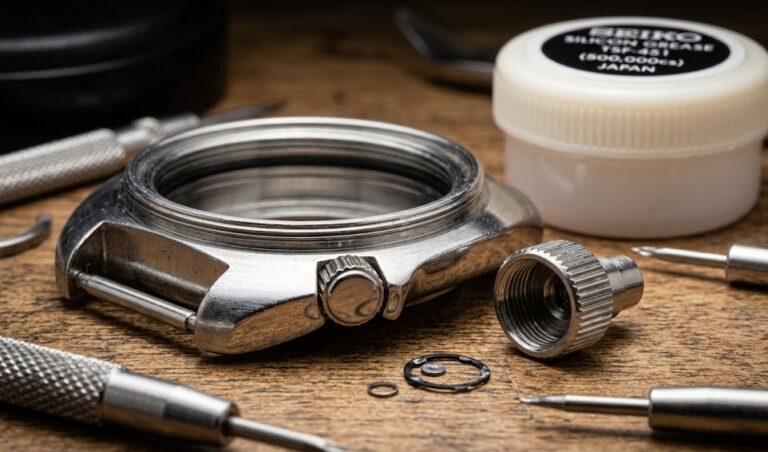
The Patina and Plexi Vintage Movement Triage Protocol: Evaluating Amplitude and Lubrication
The Patina and Plexi Vintage Movement Triage Protocol
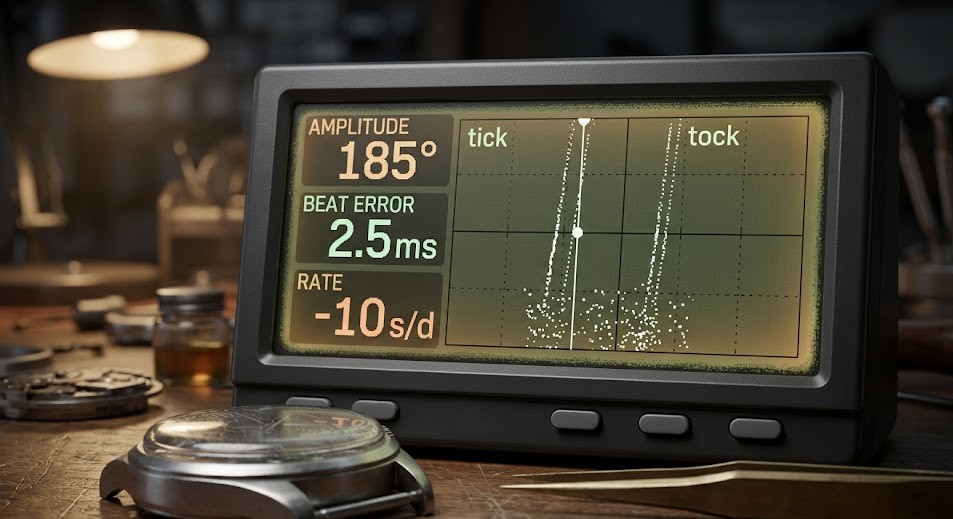
A Timegrapher screen displaying a vintage mechanical watch caliber reading with low amplitude and scattered beat error trace lines is the only objective truth when evaluating a newly acquired vintage watch. Sellers will routinely claim a piece was “recently serviced” or “runs strong.” Ignore them. Without acoustic and mathematical data confirming the friction levels at the escapement, you are blindly grinding irreplaceable steel pivots into dust.
Visual OCR and Trace Line Verification
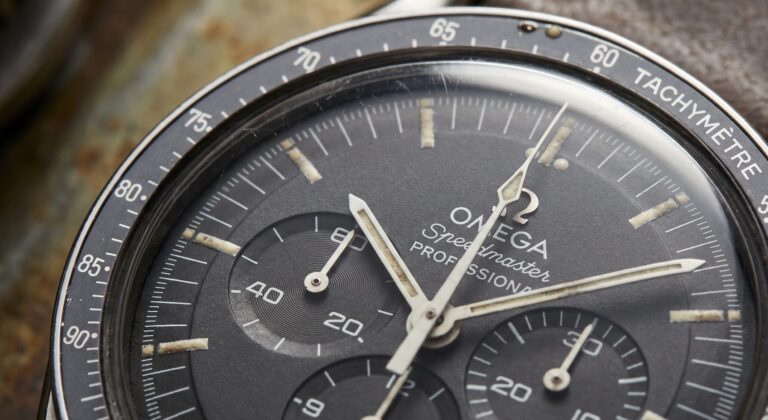
When you hook a vintage piece like an Omega Speedmaster 145.022 to a Timegrapher, you are executing a visual OCR analysis of the acoustic trace lines. You want to see two perfectly parallel, tight lines tracking across the screen. A “snowstorm” of scattered dots means the pallet fork is bouncing, the escapement is dry, or the hairspring is magnetized.
Decoding Amplitude
Amplitude measures the rotation of the balance wheel in degrees. A freshly serviced vintage mainspring with modern Moebius synthetic oils should push the balance wheel between 250° and 290° in the dial-up position. If you are registering below 200°, the oils have coagulated into a sticky paste. The watch might keep decent time for a few hours, but the friction is causing irreversible wear.
Beat Error and Isochronism
Beat error is the time difference (in milliseconds) between the “tick” and the “tock”—measuring whether the balance wheel swings equally in both directions. In modern watches, anything over 0.3ms is poor. For a 1960s workhorse, we accept up to 0.8ms. Anything over 1.0ms means the impulse jewel is not striking the pallet fork dead center, killing your power reserve.
Technical Specifications & Health Metrics
To establish a baseline for your vintage acquisitions, memorize these standard triage metrics.
- Healthy Vintage Amplitude (Dial Up)
- 240° to 290°
- Danger Zone Amplitude
- Under 200° (Stop running the watch immediately)
- Acceptable Vintage Beat Error
- 0.0ms to 0.8ms
- Average Standard Overhaul Cost (UK)
- £250 – £450 (Three-hand automatic)
- Average Chronograph Overhaul Cost (UK)
- £600 – £850+
For a deeper understanding of how modern synthetic lubrication impacts vintage jewels, refer to the technical bulletins provided by the American Watchmakers-Clockmakers Institute (AWCI).
Dealbreakers: Who This Is NOT For
Do not convince yourself that you can cut corners on maintenance. The vintage market is ruthless for the unprepared.
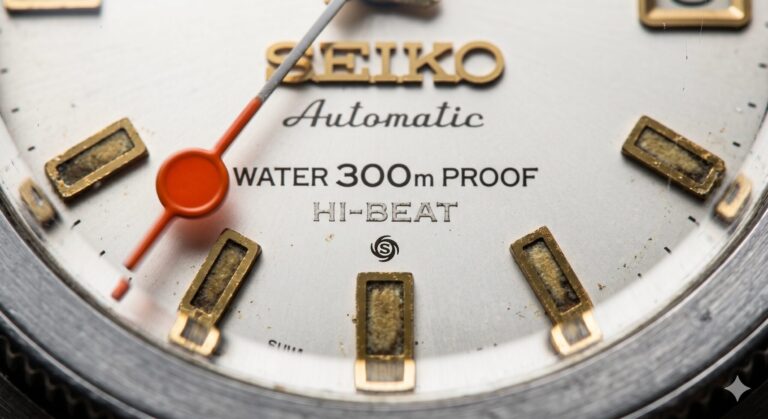
- The “Run It Until It Breaks” Fallacy: If you buy a Seiko 6159-7001 Hi-Beat 300m and run it without fresh oil, you will destroy the 36,000 bph escapement. Replacement parts do not exist. Service costs are not optional; they are a tax on vintage ownership.
- DIY Lubrication Amateurs: Do not buy a cheap oiler and attempt to lubricate the balance jewels yourself. Watchmaking requires specific Moebius oils (e.g., 9010, HP1300) applied in microscopic drops. Over-oiling stops the watch faster than no oil at all.
- Water Resistance Hopefulness: Never assume a vintage watch retains its factory seal. Even a recently serviced watch with new gaskets should be kept far away from water unless the case architecture has been pressure-tested in a wet/dry chamber.
Vintage Timegrapher Triage Calculator
Input your Timegrapher readings to instantly calculate the health of the movement and determine if an overhaul is required.
Market Acquisition Strategy
When buying unserviced vintage watches, factor the cost of an overhaul into your final bid. A £400 vintage diver that needs a £250 service is actually a £650 watch. Before purchasing, demand that sellers put the watch on a Timegrapher and send you a video of the readout.
If you are serious about triage, you need to own the hardware. You can source professional Weishi Timegraphers directly on eBay for under £150. It is the single most important investment a vintage collector can make.
Next Steps
You cannot evaluate what you cannot see. Stop guessing about the mechanical health of your grails. Search Google for “Patina and Plexi Seiko Checklists” to download our full suite of technical servicing blueprints and movement verification frameworks.