Vintage Omega Seamaster Buying Guide: The Ultimate 2026 Update
Vintage Omega Seamaster Buying Guide: The Ultimate 2026 Update
If you are looking to buy your first mid-century timepiece—or simply want a classic watch that you can actually wear every day without stressing—there is really only one answer. Welcome to our definitive vintage Omega Seamaster buying guide.
For decades, the Seamaster has been the ultimate gateway drug for watch collectors. Looking at the UK market in 2026, it remains the absolute smartest way into the hobby. But because Omega produced so many of these watches across the 1950s and 60s, the market is an absolute minefield of polished-to-death cases, terrible “frankenwatches,” and sloppy redials.
Here is exactly what you need to know to hunt down a pristine, honest vintage Seamaster this year, without getting burned on eBay or at the dealers.
Why the Mid-Century Seamaster?
Originally launched in 1948 to celebrate Omega’s 100th anniversary, the early Seamasters were designed as robust, civilian versions of the watches Omega built for the British military during WWII. That DNA is exactly why they are so beloved today.
Unlike many delicate vintage dress watches that feel like they might shatter if you look at them wrong, the Seamaster was built for daily life. When you buy a 1960s Seamaster today, you get three massive advantages:
- Movement Reliability: The manual-wind (like the 30T2 or 2xx series) and early automatic (the legendary 5xx series) movements are famously durable workhorses. They were engineered to be easily serviced, not replaced.
- Parts Availability: Because Omega made them in huge numbers, any competent watchmaker in 2026 can still easily source parts and service them. You aren’t hunting down unobtainable components to get it running.
- Value for Money: In a vintage market where hype often dictates price, standard steel Seamasters still offer unmatched bang-for-your-buck compared to equivalent pieces from Rolex, Tudor, or other prestige brands.
Vintage Omega Seamaster Buying Guide: What to Look For
When you are scrolling through UK dealer sites, auction listings, or forum classifieds, spotting an honest watch takes practice. In this section of our vintage Omega Seamaster buying guide, we break down what a solid piece looks like:
- Sharp Case Lines: Look closely at the lugs. You want to see distinct edges and original factory finishing. If the lugs look soft, melted, or asymmetrical, the watch has been aggressively polished. Walk away.
- Original Dials: A dial that shows a little warm aging (often called patina) is infinitely better than a brand-new-looking dial with a sloppy, thick font. Look for applied metal indices, clear text, and crisp Omega logos.
- The “Seahorse” Caseback: Introduced in the late 1950s, the Hippocampus (seahorse) logo on the caseback is iconic. On a good, unpolished watch, the engraving should be crisp, textured, and deep. If it is barely visible, the watch has spent way too much time on a jeweler’s polishing wheel.
What to Avoid: The Major Red Flags
The sheer volume of Seamasters means there are a lot of bad ones out there. Keep an eye out for these dealbreakers:
- The “Mumbai Special”: Brightly colored, freshly painted dials (neon green, bright red, bright yellow) that Omega never actually produced. These are almost always pieced together from leftover junk parts in overseas sweatshops.
- Moisture Damage: While they were called “Seamasters,” the rubber gaskets on a 60-year-old watch are completely compromised today. If you see black spotting or heavy corrosion on the hands and dial, the movement is likely rusting inside.
- The Wrong Crown: A replacement crown is common and not the end of the world, but it severely hurts the value for purists. Always check to see if the crown is stamped with the tiny, correct Omega logo.
Current 2026 UK Market Prices
The vintage Seamaster market is vast and constantly shifting, but here is what you should expect to pay for a watch in good, running condition right now:
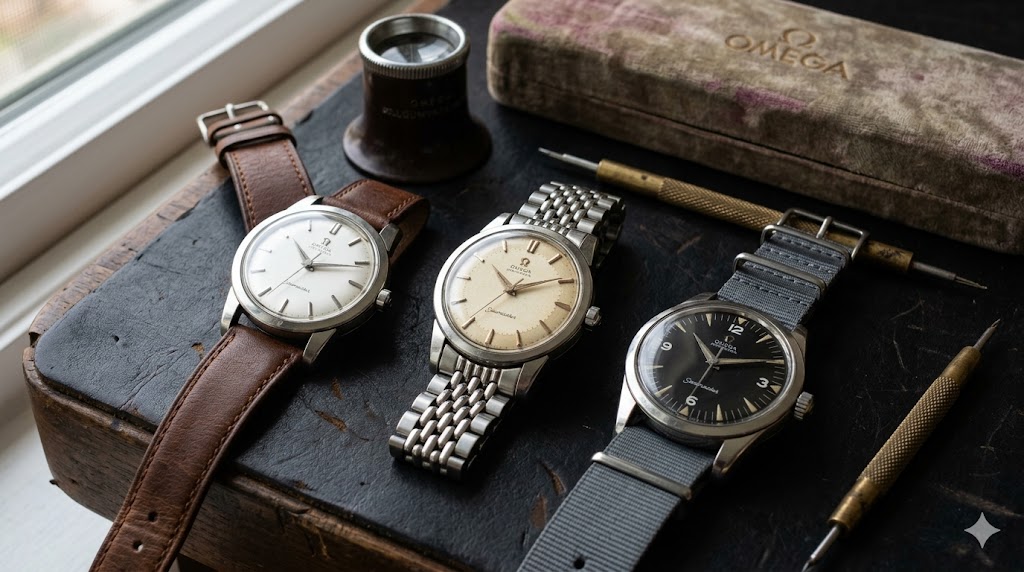
- Classic Steel Automatics (1960s): The sweet spot for collectors. Expect to pay between £800 and £1,500 depending on dial condition and whether it still has its original “beads of rice” steel bracelet.
- Manual Wind “Dress” Seamasters (1950s/60s): Slightly more accessible and incredibly elegant. You can often find stunning, sharp examples for £600 to £1,200.
- Gold-Capped Models: A great entry to precious metals without the solid gold price tag. Usually priced around £1,000 to £1,600.
- Solid 18k Gold Models: If you want serious mid-century luxury, expect to pay anywhere from £2,000 to £3,800+ depending on the reference number and condition.
The Verdict
We hope this vintage Omega Seamaster buying guide has helped demystify the market for you. A vintage Seamaster isn’t just a great entry-level watch; for many, it’s the only vintage watch they ever truly need. Take your time, always “buy the seller” before you buy the watch, prioritize an unpolished case over a pristine dial, and you will end up with a piece of history that will outlive us all.
Patina & Plexi is reader-supported. When you buy through links on our site, we may earn an affiliate commission.