The History of the “Dirty Dozen”: Collecting WWII British Military Watches
The History of the “Dirty Dozen”: Collecting WWII British Military Watches
If you want to understand the beating heart of vintage military horology, you have to look back to the early 1940s. While modern collectors often obsess over luxury dive watches and racing chronographs, true purists are continually drawn to a legendary set of twelve timepieces known as the Dirty Dozen watches.
Commissioned by the British Ministry of Defence (MoD) during the height of the Second World War, these twelve watches represent a masterclass in purpose-driven design. Today, tracking down all twelve is considered one of the ultimate quests in watch collecting. Whether you are hunting for your first piece of military history or trying to complete the full set, here is everything you need to know about the W.W.W. (Watch, Wrist, Waterproof) specification and the current 2026 UK market.
What Are the Dirty Dozen Watches?
By 1944, the British military realized that civilian watches simply weren’t surviving the brutal conditions of trench, naval, and aerial warfare. The MoD urgently needed a standardized, highly durable field watch for its specialized units. Because British watchmakers were entirely focused on building aviation instruments and naval chronometers for the war effort, the MoD turned to neutral Switzerland.
They issued a strict set of specifications that every watch had to meet. The requirements for what would become the Dirty Dozen watches were uncompromising:
- The Dial: Matte black to prevent glare, with clear, highly legible Arabic numerals.
- The Hands: Luminous hands (painted with highly radioactive Radium) for night visibility, typically in a sword or syringe style.
- The Case: Stainless steel or plated cases that were waterproof and highly shock-resistant.
- The Movement: A highly accurate 15-jewel manual-wind movement, regulated to chronometer standards.
- The Markings: The iconic “Broad Arrow” (the mark of British Crown property) on the dial and engraved on the caseback, alongside the W.W.W. designation.
The 12 Swiss Manufacturers
Twelve Swiss companies stepped up to meet the MoD’s strict criteria and deliver the watches before the war ended. The brands that make up the Dirty Dozen are:
Buren, Cyma, Eterna, Grana, Jaeger-LeCoultre (JLC), Lemania, Longines, IWC, Omega, Record, Timor, and Vertex.
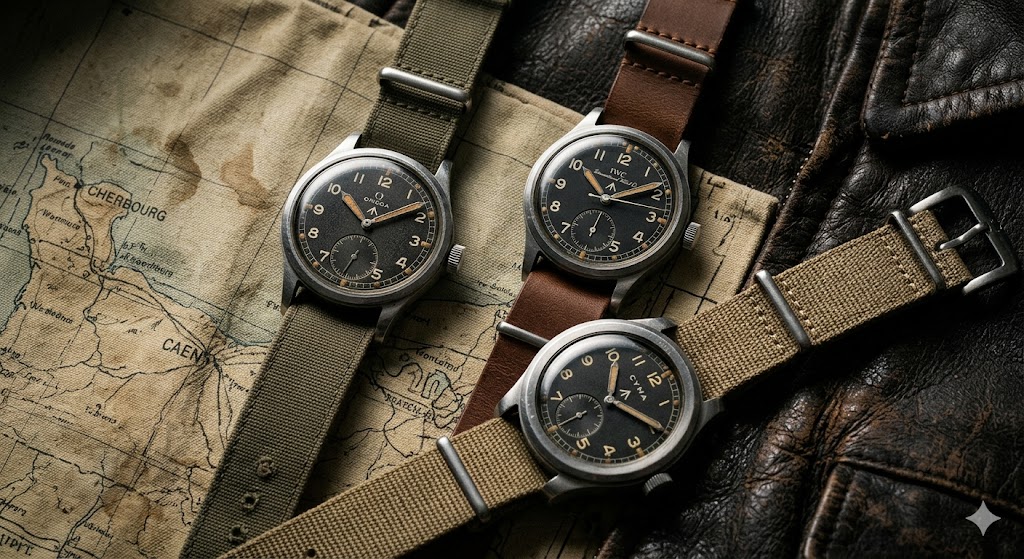
Interestingly, Vertex was the only company with British roots, though the watches were still manufactured in Switzerland. While they all shared the exact same MoD specifications, each brand interpreted the design slightly differently. The Longines, for example, features a larger, more pronounced 38mm stepped case, while the JLC features beautiful cathedral-style hands.
The Holy Grail: Why the Grana is So Rare
If you are attempting to collect all twelve, you will quickly hit a massive roadblock: the Grana.
While companies like Omega and Record produced tens of thousands of units for the British forces, Grana is estimated to have produced fewer than 5,000—and some horological historians believe the number of surviving pieces is closer to 1,000. Because of this extreme scarcity, a collector can spend years waiting for a Grana to surface at auction. It is the bottleneck of the Dirty Dozen, and its price reflects its mythical status.
2026 UK Market Prices for the Dirty Dozen
Military watches have seen a massive surge in popularity, and prices have adjusted accordingly. Because these were literal tools of war, finding examples with unpolished cases, original Radium dials (beware of post-war MoD replacement dials, known as “NATO dials”), and matching serial numbers requires diligence.
Here is what you can expect to pay from trusted UK military dealers or auction houses today:
- The Entry Level (Record, Timor, Buren): These are fantastic, accessible entry points into WWII history. Expect to pay between £1,400 and £2,200 for honest examples.
- The Heavyweights (Omega, Cyma, Vertex): Thanks to brand recognition and slightly larger case sizes (the Cyma is a robust 37mm), these highly sought-after models generally trade between £2,500 and £3,500.
- The Premium Tier (IWC, JLC, Longines): The craftsmanship on these pieces commands a premium. The IWC (Caliber 83) and Longines (“Greenlander”) will easily pull between £4,500 and £7,000 depending on patina.
- The Grana: If you can find one, be prepared to open your wallet. A Grana in good condition will frequently hammer at auction for £12,000 to £18,000+.
The Verdict
Owning one of the Dirty Dozen watches is about more than just telling the time; it is about preserving a piece of world history. These watches survived the beaches, the trenches, and the mud of the 1940s. If you are buying your first, prioritize matching numbers (the serial number on the lug should match the caseback) and original Radium dials. Strap it onto a vintage canvas NATO, and wear a piece of horological bravery on your wrist.
Patina & Plexi is reader-supported. When you buy through links on our site, we may earn an affiliate commission.