
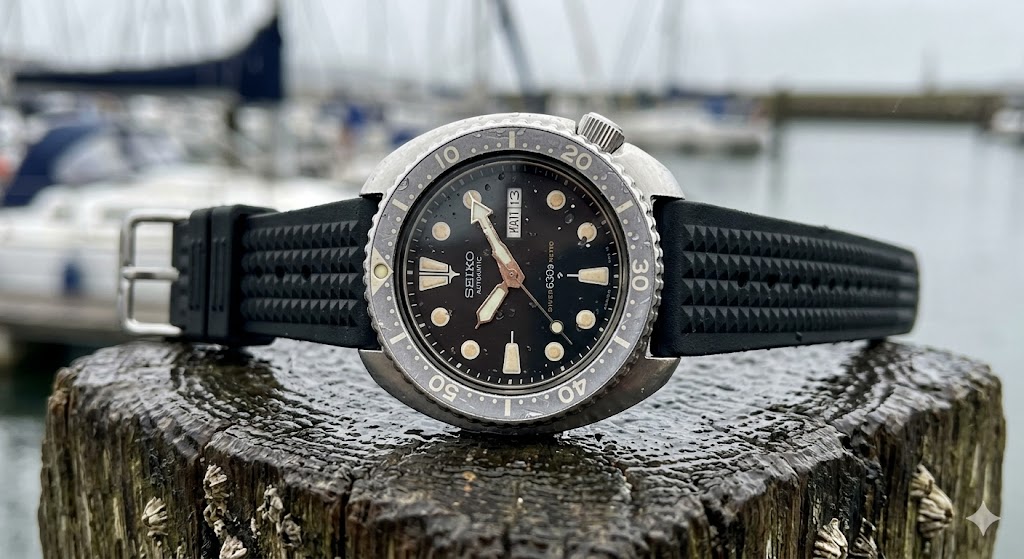
Hands-On Review: The Iconic Seiko 6309-7040 ‘Turtle’ Diver
Hands-On Review: The Iconic Seiko 6309-7040 ‘Turtle’ Diver
There are very few watches that genuinely earn the title of “legend.” Even fewer manage to achieve legendary status while remaining accessible to the everyday collector. Yet, that is exactly what Seiko accomplished with the reference 6309-7040. Welcome to our in-depth, hands-on vintage Seiko Turtle review.
Produced between 1976 and 1988, the 6309 succeeded the famous 6105 “Captain Willard” (made famous in Apocalypse Now). While the Willard was slightly quirkier, the 6309-7040 established the core design language that Seiko diver’s would follow for decades. In 2026, the demand for these cushion-cased tools remains incredibly high in the UK, making them a staple in many collections. But after decades of exposure to saltwater, coral, and enthusiastic hobbyist watchmakers, are they still worth buying? We strapped an honest, original example on the wrist to find out.
The Cushion Case: Form and Function
The first thing that strikes you about the 6309 is the case. Measuring roughly 44mm in diameter, it sounds massive by vintage standards. However, like many of Seiko’s classic divers, those numbers are deceptive.
The watch has no traditional lugs. Instead, the strap fits directly into the massive, sweeping cushion case. This results in a incredibly short lug-to-lug measurement of just under 48mm. When we tested this on a standard 7-inch wrist, the 6309-7040 hugged the arm perfectly. It doesn’t overhang, and the asymmetric, recessed crown at 4 o’clock ensures that it never digs into the back of your hand. It is, perhaps, the most comfortable 44mm watch ever made.
Furthermore, the polished top surfaces of the cushion case contrast beautifully with the brushed sides, creating an aesthetic that looks right at home on a rugged rubber strap, a canvas NATO, or even a vintage steel bracelet. The massive Hardlex crystal (Seiko’s proprietary mineral glass) adds to the substantial, unbreakable feel of the watch.
Vintage Seiko Turtle Review: The Dial and Wearability
The dial of the 6309-7040 is a masterclass in legibility. As a true ISO-certified ISO tool watch, nothing is here for show. The matte black dial features massive, applied hour indices that are highly visible against the dark background.
What makes a great vintage Seiko Turtle review is discussing the character, or patina. A pristine 6309 dial is rare. Instead, collectors look for “good patina.” On our review example, the original tritium lume had aged to a stunning, warm creamy yellow. This “plexi” charm contrasts perfectly with the stark white dial text and the iconic “Suwa” symbol (which looks like a small vortex) located above the 6 o’clock marker on Japanese-made models.
On the wrist, the watch is incredibly balanced. It is powered by the 6309A movement, a rugged, 17-jewel automatic caliber known for its durability. While it is non-hacking (the second hand doesn’t stop when you pull the crown) and non-quickset for the date (requires winding past midnight), it is famously reliable. Even after decades without service, many 6309s still beat strong, although we *always* recommend a service for any vintage purchase to ensure timing accuracy.
2026 UK Collector Values and Red Flags
The vintage Seiko market is lucrative, but it is an absolute minefield. In this critical section of our vintage Seiko Turtle review, we must emphasize the importance of looking for “all-original” components.
Because these watches were affordable tool watches for decades, many have been poorly repaired or modified. The UK secondary market is flooded with “Franken Turtles”—watches with aftermarket dials, fake hands, and soft, cheap replacement bezel inserts. Here is what to watch out for:
- The Dial Text: Aftermarket dials often have font that is slightly too thick or fuzzy. The original Suwa symbol is crisp.
- The Hands: Genuine hands have a specific metallic sheen and perfectly matching lume patina. Beware of bright white replacement hands on a creamy dial.
- Bezel Lume Pip: The original bezel insert features a small luminous dot at 12 o’clock that is recessed behind a small glass lens. Replacement inserts almost always have a flat, painted pip that sits flush with the surface. Walk away.
Here is what you should expect to pay for an original, running 6309-7040 Turtle in the UK right now:
- Honest, Running Condition (Good Patina): For a watch with original parts but honest signs of wear, expect to pay between £600 and £900.
- Pristine, Collector Grade (Suwa Dial): A truly perfect, sharp, and original example, particularly if it has the coveted “Suwa” dial, can now push past £1,000 to £1,500.
- Serviced & Water Tested: If a dealer has fully serviced the movement and pressure tested the case, you will pay a premium, typically in the £800 to £1,200 range.
The Verdict
The Seiko 6309-7040 is the definitive vintage tool watch. It is incredibly comfortable on the wrist, historically significant, and built like a tank. It possesses a rugged charisma that modern re-issues completely fail to capture. While you must navigate the UK market with caution to avoid aftermarket parts, owning an honest 6309-7040 is one of the most rewarding experiences in horology. Strap it on, and you can feel the decades of adventure on your wrist.
Patina & Plexi is reader-supported. When you buy through links on our site, we may earn an affiliate commission.