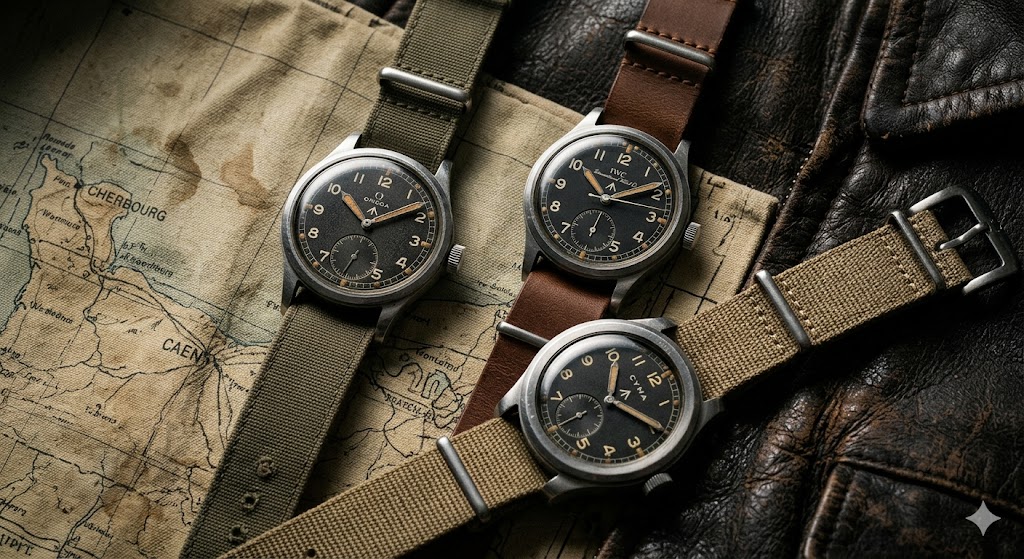
The History of the “Dirty Dozen”: Collecting WWII British Military Watches
The Complete Dirty Dozen Watches Guide: WWII Military Horology (2026)
Walking past the war memorial down by Old Steine on a crisp Sussex morning, it’s hard not to think about the tangible pieces of history that survived the Second World War. For horology enthusiasts, nothing represents the raw, functional aesthetic of that era quite like the “Dirty Dozen.” If you are looking to add serious, combat-tested heritage to your collection, this Dirty Dozen watches guide will break down everything you need to know about these iconic military-issued timepieces.
These aren’t delicate dress watches meant for boardrooms. They were heavily standardized, rugged tools built to survive the trenches, the sea, and the air. Today, assembling a complete set of all twelve manufacturers is considered one of the holy grails of vintage collecting.
What Are The Dirty Dozen Watches?
During WWII, the British Ministry of Defence (MoD) needed highly reliable, legible watches for their armed forces. British watchmaking couldn’t meet the massive production demands, so the MoD turned to neutral Switzerland. They issued a strict set of specifications, and twelve different Swiss companies stepped up to fulfill the order.
The MoD Specifications
Every single watch in the Dirty Dozen had to look and function almost identically, regardless of whether it was made by Omega or a lesser-known brand like Record. The requirements were uncompromising.
The W.W.W. Engraving
Turn one of these watches over, and you will find the letters “W.W.W.” stamped into the steel caseback. This stands for “Watch, Wrist, Waterproof.” It is the absolute quickest way to identify an authentic piece. Along with this, the casebacks and dials feature the “Broad Arrow” (or pheon) mark, denoting property of the British Crown.
Dial and Movement Standards
The MoD mandated matte black dials for maximum contrast, luminous hands and hour markers (using radium at the time), a shatterproof acrylic crystal, and a sub-seconds dial at 6 o’clock. The movements had to be highly accurate 15-jewel manual wind calibers.
Collector’s Tip: Due to their historical significance, these watches rarely lose value. Browse authenticated WWII Dirty Dozen listings on eBay UK.
The Twelve Manufacturers
The twelve companies that produced these watches were Buren, Cyma, Eterna, Grana, Jaeger-LeCoultre, Lemania, Longines, IWC, Omega, Record, Timor, and Vertex. Finding all twelve is a monumental task, largely because production numbers varied wildly. For instance, Omega produced around 25,000 units, while Grana produced fewer than 5,000, making the Grana the undeniable bottleneck for collectors.
Accessible Entry Points
If you don’t have £10,000 to drop on an IWC Mark X or a Grana, there are still fantastic ways to get into this category without emptying your bank account.
Vertex and Record
Brands like Vertex and Record had higher production runs, meaning they pop up on the secondary market with much more frequency. You can often secure an honest, functioning example from these manufacturers for a fraction of the cost of the big-name brands, while still owning the exact same military history.
The Heavy Hitters
If you are looking for investment-grade pieces from legendary Swiss houses, three brands usually dominate the conversation.
Omega, Longines, and IWC
The Omega variant is highly prized for its incredibly robust 30T2 movement. The Longines stands out because it features a slightly larger 38mm stepped case (often called the “Greenlander”), making it incredibly wearable by modern standards. The IWC, famously known as the Mark X, features a beautiful snap-on caseback and exceptional finishing.
Authentication and Collecting Tips
Buying military watches requires a sharp eye. Because these were MoD property, they were routinely sent back to the Royal Electrical and Mechanical Engineers (REME) for servicing. During the war, REME watchmakers didn’t care about “matching numbers” or “collector value”—they just needed to get the watch back to the front lines. It is extremely common to find a Record dial inside a Cyma case. These are known as “MoD redials” or “Frankens.” While MoD redials are historically accurate to the military servicing process, they command lower prices than factory-original, matching pieces.
The Radium Warning
A crucial detail in any Dirty Dozen watches guide is the lume. The original luminous material was highly radioactive Radium-226.
Safe Handling Practices
While wearing a radium watch is generally considered safe as the steel case blocks most of the harmful radiation, you should never open the caseback yourself. Inhaling or ingesting the flaking radioactive dust is highly dangerous. Leave servicing strictly to professional horologists equipped to handle vintage lume.
2026 UK Market Prices
Prices fluctuate based on the specific manufacturer, condition, and whether the parts are entirely matching from the factory.
- Entry-Level (Record, Timor, Vertex): £1,200 – £2,000
- Mid-Tier (Omega, Cyma, Buren): £2,000 – £3,500
- High-End (Longines Greenlander, IWC Mark X): £4,000 – £8,000+
- The Grana: £10,000+ (if you can even find one)
Ready to own a piece of military history?
Shop Authenticated WWII Military Watches
The Verdict
The Dirty Dozen represents a singular moment when necessity created a design language so perfect that brands are still desperately trying to copy it eighty years later. By understanding the MoD specifications, recognizing the value of the different manufacturers, and using the tips in this Dirty Dozen watches guide, you can secure a genuine artifact from the 20th century’s most defining conflict.
Patina & Plexi is reader-supported. When you buy through links on our site, we may earn an affiliate commission.