The Ultimate Vintage Rolex Datejust 1601 Buying Guide (2026 UK Market)
The Ultimate Vintage Rolex Datejust 1601 Buying Guide (2026)
If you were to ask a room full of horologists to draw a luxury watch from memory, the majority would sketch a Rolex Datejust. It is the archetype. Within that legendary lineage, the Reference 1601 stands out as the quintessential vintage model. Offering the perfect blend of mid-century charm and everyday reliability, this vintage Rolex Datejust 1601 buying guide will walk you through exactly what to look for when hunting for the ultimate one-watch collection.
The first time I handled a 1601, it belonged to a retired architect I met down by the Hove promenade. It was on a heavily stretched Jubilee bracelet that rattled like an old bicycle chain, but the silver dial caught the autumn light beautifully. He had worn it every single day since 1972. That is the appeal of the 1601—it isn’t a safe queen; it is a watch meant to be lived in.
Understanding the Reference 1601
Produced from the late 1950s all the way through the 1970s, the 1601 is the watch that cemented the Datejust’s visual identity. While modern iterations have grown thicker and shinier, the 1601 retains a graceful 36mm profile that sits perfectly on almost any wrist.
The White Gold Fluted Bezel
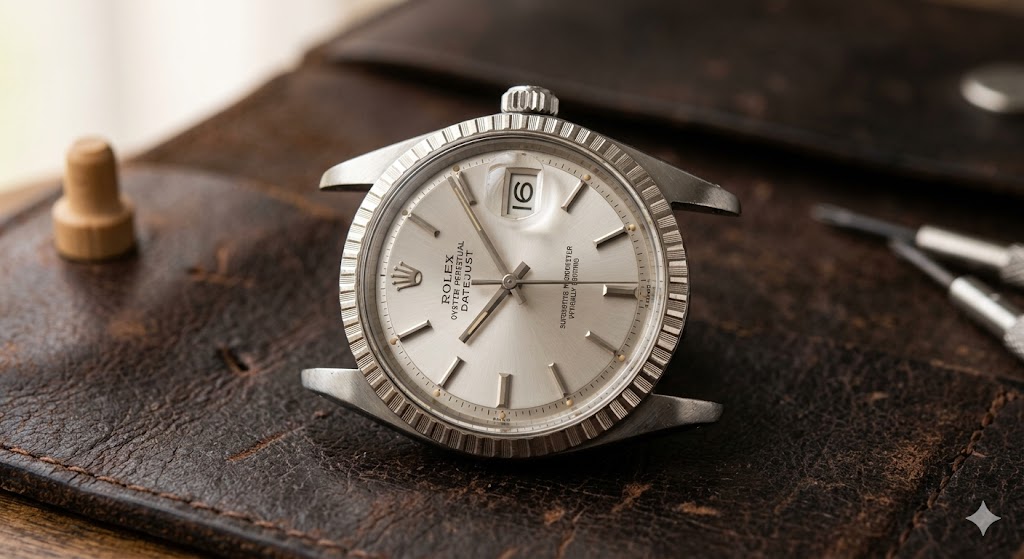
The defining characteristic of the 1601 is its fluted bezel, crafted from solid 18k white gold (or yellow gold on two-tone models). Over decades of wear and polishing, these sharp flutes often soften, gleaming with a warm, subtle glow that modern, sharply machined bezels simply cannot replicate.
The “Pie-Pan” Dial
Unlike modern, entirely flat dials, the 1601 features a stepped edge that dips down toward the minute track. Collectors affectionately call this the “pie-pan” dial. It adds a wonderful sense of depth and dimension under the thick acrylic crystal, making it a critical detail to verify when authenticating.
The “Sigma” Dial Variation
When hunting for a 1601, keep an eye out for dials with two small lowercase Greek sigma letters (σ) printed at the very bottom, flanking the “T SWISS T” text. This indicates that the hands and hour markers are made of solid gold, rather than steel. Sigma dials carry a distinct premium in the collector community.
The “Wide Boy” Dial Variation
Another highly sought-after variant is the “Wide Boy.” These dials feature unusually wide, blocky hour markers paired with equally thick, flat hands. It gives the typically dressy Datejust a much chunkier, sportier appearance and is incredibly popular among modern enthusiasts.
Collector’s Tip: Due to the sheer number of fakes on the market, buying a Rolex requires strict safeguards. Browse authenticated Vintage Rolex Datejust 1601 listings on eBay UK.
The Heart of the Watch: Calibers 1560 and 1570
Rolex built its reputation on bomb-proof movements, and the calibers inside the 1601 are legendary. Early models feature the Caliber 1560, while later models were upgraded to the Caliber 1570. Both are chronometer-certified, automatic movements.
It is important to note that these are “non-quickset” movements. This means that if the watch stops, you cannot simply pull the crown out one click to change the date; you have to wind the hands forward past midnight repeatedly. It is a charming, slightly tedious quirk of true vintage ownership.
Condition Red Flags and What to Look For
When studying any vintage Rolex Datejust 1601 buying guide, learning how to evaluate condition is paramount. A cheap 1601 is often the most expensive watch you can buy once repair bills factor in.
Jubilee Bracelet Stretch
The folded steel links of a vintage Jubilee bracelet will stretch over time as dirt and sweat grind away the metal pins. Hold the watch by the watch head; if the bracelet droops at a severe 90-degree angle, it will need a costly restoration by a specialist to make it wearable again.
Lume Degradation
Original 1601 dials used tritium for the glowing hour dots and hands (indicated by “T SWISS T” at the bottom of the dial). Tritium degrades over time, turning a creamy yellow or pumpkin color. Ensure all the lume plots are intact; missing plots or a dial that glows brightly in the dark (indicating modern replacement parts) severely hurts the value.
2026 UK Market Prices
The 1601 remains one of the safest places to park money in the vintage watch world, though finding unpolished examples is becoming increasingly difficult.
- Watch Head Only (No Bracelet): £2,800 – £3,200
- Good Condition (Stainless Steel with Jubilee): £3,500 – £4,200
- Excellent Unpolished Condition (Rare Dial Colors): £4,500 – £5,500+
Ready to invest in an icon?
Shop Authenticated Rolex 1601 Models
The Verdict
The Rolex Datejust 1601 is the definition of a “one-watch collection.” It looks just as appropriate paired with a faded t-shirt as it does slipping under the cuff of a tailored suit. By avoiding heavily polished cases and stretched bracelets, and utilizing the knowledge in this vintage Rolex Datejust 1601 buying guide, you can secure a piece of horological history that will easily last another fifty years.
Patina & Plexi is reader-supported. When you buy through links on our site, we may earn an affiliate commission.